





























































































































Samsung’s Galaxy XR Takes Aim at Apple’s Vision Pro — Offering a High-End Mixed Reality Experience at Half the Price
Samsung has officially entered the mixed reality race with the launch of Galaxy XR, its long-anticipated Android XR headset. The device — co-developed with Google and Qualcomm — promises a fully immersive experience that rivals Apple’s Vision Pro, but at a far more accessible price of $1,800, roughly half the cost of Apple’s $3,500 headset.
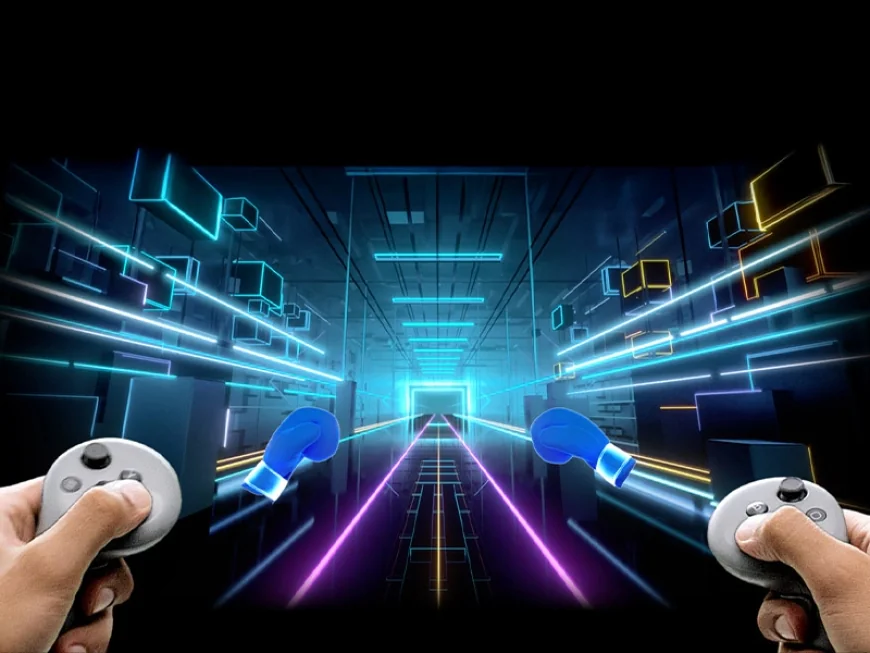
The Galaxy XR marks Samsung’s bold step into the XR (extended reality) market, combining advanced display technology, integrated AI, and a robust ecosystem of Google applications to position itself as a serious contender in the spatial computing space.
A Familiar Design with Key Differences
The Galaxy XR bears a strong resemblance to Apple’s Vision Pro in both appearance and functionality. Weighing 545 grams, it is slightly lighter than the Vision Pro (600 grams) and offloads weight through a tethered external battery, similar to Apple’s design.
Both headsets use micro-OLED displays, though Samsung’s are sharper — with a 3,552 × 3,840 resolution per eye — offering around 13.6 megapixels compared to Vision Pro’s 11.7 megapixels.
Built on the Android XR platform, the headset supports multiple floating windows and natural interaction through “look and pinch” gestures, laser-pointer control, or hand tracking. Like VisionOS, Android XR allows users to run standard Android apps, meaning millions of existing mobile apps can operate seamlessly in the 3D environment.
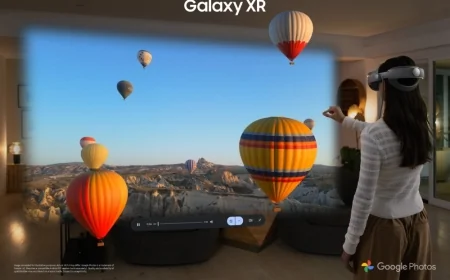
Apps like Google Photos are optimized for XR, allowing users to view immersive 3D versions of their images or transform them into animated video memories. Meanwhile, Google’s Lifelike Avatars, a counterpart to Apple’s “Personas,” are expected to launch with the headset or arrive via a software update.
Deep Integration with Google’s Ecosystem
Samsung’s biggest advantage lies in its access to Google’s digital ecosystem. The Galaxy XR launches with native XR versions of key Google services including YouTube, Maps, Chrome, Meet, Search, and Google TV — features that Apple users won’t find in VisionOS.
The YouTube XR app is particularly noteworthy, supporting 180°, 360°, and 3D videos, and even testing AI-powered 2D-to-3D video conversion for more immersive viewing.
Google Maps XR allows users to explore Earth in fully rendered 3D environments, echoing the experience of Google Earth VR.
Galaxy XR also supports virtual desktop streaming, enabling users to project their PC workspace into a vast virtual environment. Optional motion controllers will provide more precision for gaming and creative applications, though these were not demonstrated during early tests.
AI as the Core Experience
What sets Galaxy XR apart is its deep integration with Gemini, Google’s advanced multimodal AI assistant. Unlike Siri on Vision Pro, Gemini has environmental awareness — it can interpret both what users see in the real world and what appears in their virtual space.
This enables contextual interactions such as:
-
Watching a trailer and asking, “Gemini, is this game out yet?”
-
Seeing a landmark in a video and asking, “Where is this?”, followed by “Show me in Google Maps.”
-
Using the Circle to Search feature to identify real-world objects or online visuals by simply circling them in the air.
Gemini’s ability to process visual, spatial, and conversational cues positions Galaxy XR as the first truly AI-native XR headset, designed to merge intelligent assistance with immersive computing.
A More Accessible Step into Spatial Computing
With its $1,800 price tag, Galaxy XR is not inexpensive — but it represents a more approachable gateway into mixed reality compared to Apple’s offering. It delivers most of the Vision Pro’s premium features, plus several unique integrations that take advantage of Google’s open ecosystem and AI capabilities.
Early testers have praised the display quality, app flexibility, and AI-enhanced contextual awareness. While questions remain about battery life, comfort, and real-world use cases, the Galaxy XR stands as a major milestone in making immersive, AI-driven spatial computing more accessible.
Samsung’s entry could spark renewed competition and innovation in the XR market — accelerating the transition from concept to mainstream technology.