





































































































































Interstellar Object 3I/ATLAS Exits Solar System After Closest Solar Approach
The third-known interstellar visitor to our solar system, 3I/ATLAS, has passed its closest point to the Sun and is now on its outbound trajectory. The comet, believed to originate from another star system, reached perihelion at 11:47 UTC (6:47 a.m. CDT) on October 29, 2025, at a distance of 1.36 AU (roughly 200 million km) from the Sun. Its nearest approach to Earth is still ahead, projected for December 19, 2025, at about 1.8 AU (270 million km).
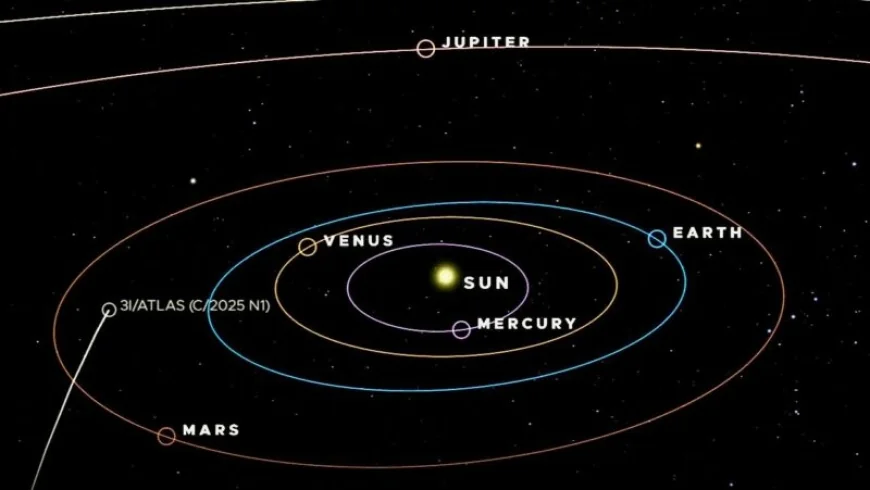
Currently, the comet is behind the Sun from Earth’s perspective, making it invisible to the naked eye. Observers will need at least an 8-inch (20 cm) telescope to spot it when it reappears in the eastern predawn sky around November 11. Despite this, the NOAA CCOR-1 coronagraph aboard the GOES-19 satellite has captured images of 3I/ATLAS, with citizen scientist Worachate Boonplod credited with its discovery in the coronagraph data.
Observations and Space Missions
3I/ATLAS made headlines during its close approach to Mars on October 2-3, 2025, passing approximately 18 million miles (29 million km) from the planet. ESA’s ExoMars Trace Gas Orbiter (TGO) and Mars Express observed the object, with TGO’s CaSSIS instrument capturing faint images of the comet as a “slightly fuzzy white dot” against streaked stars.
Meanwhile, the European Space Agency’s JUICE mission will observe the comet between November 2-25, 2025, aiming to capture detailed data on its active state, bright halo, and tail. Results from these observations are expected in February 2026.
Tracing the Origins
Origin studies suggest 3I/ATLAS came from the Sagittarius direction, toward the center of the Milky Way. Astronomers led by Xabier Pérez-Couto of the University of A Coruña traced its path back 10 million years, analyzing data from the Gaia space observatory. While 93 stellar encounters were identified along its path, none significantly influenced its trajectory. Its motion suggests an origin in the Milky Way’s thin disk, composed of younger stars, although the object itself may be billions of years old.
Researchers describe 3I/ATLAS as a “key probe of the galactic population of icy planetesimals,” offering insights into solar system formation, the distribution of volatiles, and the dynamics of planetary systems. Its interstellar journey highlights the chaotic processes of planet formation and debris ejection in young star systems.
Physical Characteristics
Size estimates have evolved since discovery. Initially thought to be 12 miles (20 km) in diameter, further observations from the Vera C. Rubin Observatory and Hubble Space Telescope revised the estimate to 3.5 miles (5.6 km), with the possibility it could be as small as 1,050 feet (320 meters).
For context, previous interstellar objects include 1I/‘Oumuamua, roughly 656 feet (200 meters) across, and 2I/Borisov, under 1 km. Analysis by astronomers suggests 3I/ATLAS could be the oldest comet observed, potentially over 7 billion years old, predating our solar system.
Discovery and Detection
3I/ATLAS was first detected on July 1, 2025, by the Asteroid Terrestrial-impact Last Alert System (ATLAS). Its interstellar origin was confirmed by the Minor Planet Center on July 2. Hubble imaged the object on July 21, 2025, providing further insights into its structure and activity. Traveling at approximately 130,000 miles per hour (210,000 km/h), it is the fastest recorded visitor to our solar system.
While no dedicated spacecraft mission is planned for 3I/ATLAS, ESA’s upcoming Comet Interceptor mission is designed to intercept future interstellar objects, allowing scientists to study such visitors more closely.
Viewing 3I/ATLAS
Amateur astronomers can track the comet using NASA’s Eyes on the Solar System tool and specialized apps. Though invisible to the naked eye, telescopic observers can catch glimpses in the predawn sky from mid-November, joining professional missions in studying this interstellar traveler.
3I/ATLAS exemplifies the extraordinary journey of small icy objects through the galaxy, offering a rare opportunity to study materials formed in distant star systems, shedding light on the origins of planets and the dynamics of our Milky Way.