






























































































































Artificial intelligence revolutionizes search for fast radio bursts and technosignatures
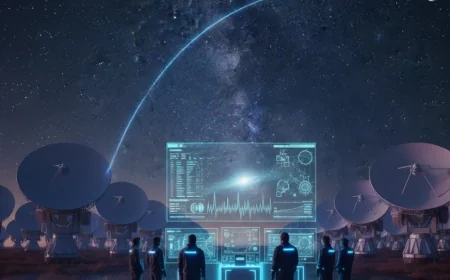
Researchers from the Breakthrough Listen initiative, in collaboration with NVIDIA, have developed a groundbreaking artificial intelligence system for the Allen Telescope Array in California that drastically accelerates the search for Fast Radio Bursts (FRBs). The new end-to-end deep learning algorithm processes observational data over 160 times faster than real-time constraints and significantly reduces false positives. This technological leap represents a paradigm shift for FRB astronomy and holds immense potential for the search for technosignatures—signals from extraterrestrial civilizations.
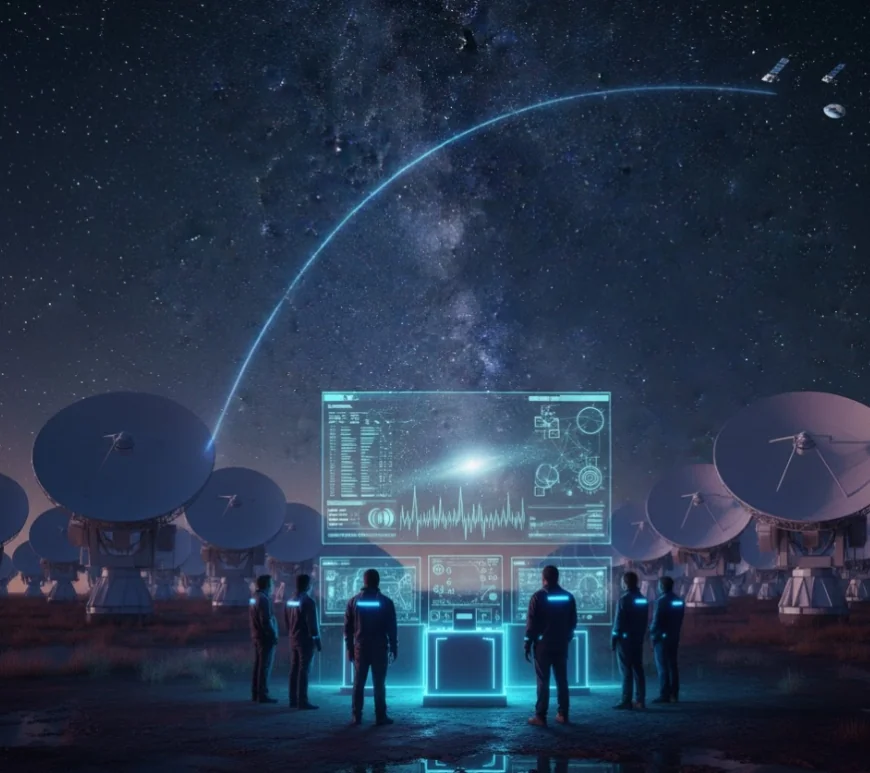
In an exciting leap forward for astronomy, researchers have achieved a groundbreaking advancement in the search for Fast Radio Bursts (FRBs). The team, part of the Breakthrough Listen initiative and working in partnership with NVIDIA, developed an artificial intelligence system that dramatically outperforms existing detection methods while operating at unprecedented speeds. The new technology promises to revolutionize not only FRB astronomy but also the search for technosignatures—potential signals from extraterrestrial civilizations.
The system has been deployed on the Allen Telescope Array in California. It leverages the NVIDIA Holoscan platform, which is designed for processing massive streaming datasets, enabling the system to process data in real-time without requiring traditional, time-consuming "dedispersion" techniques that analyze thousands of possible signal parameters.
Staggering Performance Improvements
The performance improvements achieved by the new AI system are staggering. The current state-of-the-art pipeline at the Allen Telescope Array runs almost four times slower than real-time, taking approximately 59 seconds to process just 16.3 seconds of observational data. The new end-to-end AI system processes the exact same data 600 times faster, allowing it to operate over 160 times faster than real-time constraints.
The lead researcher, now a graduate student at UC Berkeley, emphasized that this capability represents a paradigm shift in how scientists search for fast transient phenomena across the cosmos. The system can outpace massive data streams while maintaining the sensitivity needed to detect the unexpected.
Crucially, the system achieved a 7% better accuracy than existing pipelines while reducing false positives by nearly 10-fold. This drastic reduction is essential for future surveys that must sift through millions of candidate signals, including potential technosignatures that could easily be masked by false alarms. Rapid and precise detection is vital, as it allows for immediate follow-up observations that could help astronomers pinpoint the source events of FRBs or potentially confirm evidence of intelligent life beyond Earth.
New Possibilities for Technosignature Research
The AI system's ability to recognize complex signal patterns opens entirely new possibilities for technosignature research.
The Principal Investigator for the Breakthrough Listen Initiative stated that this technology does more than just accelerate the finding of known signal types; it enables the discovery of completely unexpected signal morphologies. The system can learn to recognize patterns that a human might miss entirely, potentially identifying burst-like communications, modulated signals, or transmission schemes used by an advanced civilization.
In an initial test, the AI successfully detected giant pulses from the Crab Pulsar, easily handling the massive 86 gigabit per second data stream. This technology could be deployed at telescopes globally, creating a planetary-scale detection system for both natural phenomena and potential extraterrestrial signals.
This latest research builds upon earlier groundbreaking work by scientists and engineers at Breakthrough Listen and collaborators, pushing the boundaries of what real-time AI processing can achieve in astronomy and the search for life. Breakthrough Listen, headquartered at the University of Oxford, is the world’s most comprehensive search for technosignatures, surveying millions of stars and entire galaxies using powerful radio telescopes and observatories. The initiative is funded by the Breakthrough Foundation.