





















































































































Global policy uncertainty surges despite positive economic sentiment
Global economic uncertainty has doubled since January, driven by geopolitical rifts and policy shifts. The new World Policy Uncertainty Index shows that despite this record-high policy uncertainty, the World Sentiment Index remains positive, suggesting global economic resilience and an optimistic outlook, according to analysis of Economist Intelligence Unit reports covering 71 economies.
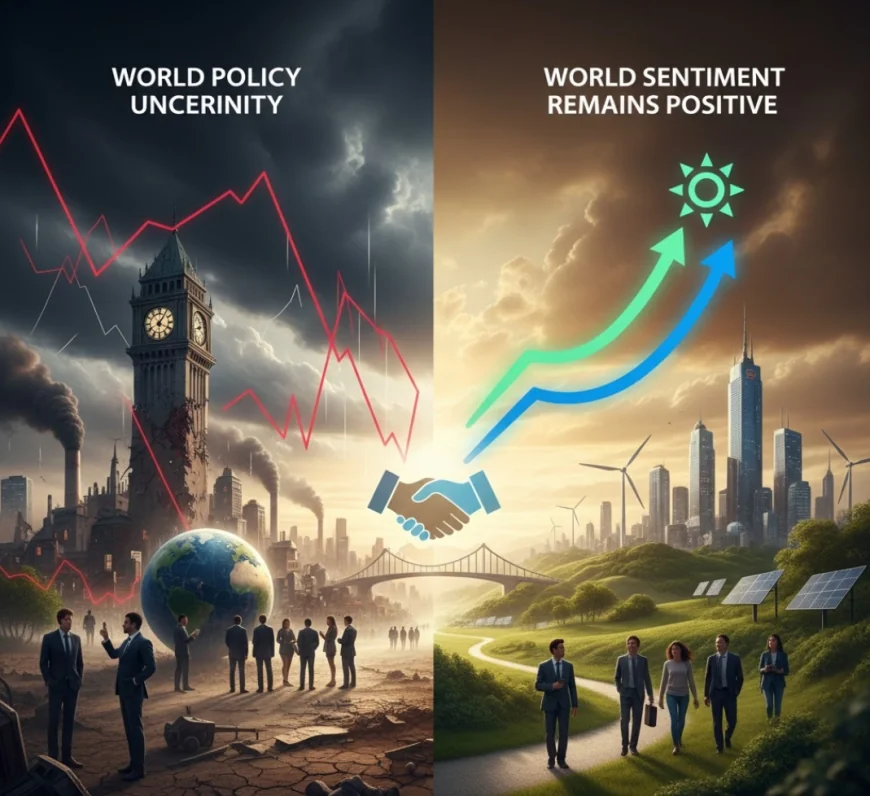
Amid rising geopolitical rifts and trade tensions, global economic uncertainty has surged, yet sentiment about economic prospects remains surprisingly positive.
According to the World Uncertainty Index, major policy shifts this year have caused uncertainty about the future and policy decisions to double since January. Global uncertainty has reached an exceptionally high level and is likely to persist, echoing recent warnings from the IMF.
To better understand the drivers, a new subcomponent was developed: the World Policy Uncertainty Index. This new gauge tracks reports by the Economist Intelligence Unit, tallying country-level references to terms like “uncertain” or “uncertainty” in passages related to “policy,” “policymaking,” or politics (e.g., “election,” “government,” “vote”). It covers 71 advanced countries, emerging markets, and developing economies.
The analysis shows that a recent record monthly level for policy uncertainty was accompanied by relatively upbeat readings for the World Sentiment Index. This resilience aligns with recent IMF forecasts that the global economy remains resilient and is slowing only modestly. This stability can be attributed to improved policies, especially in emerging markets, alongside better business adaptability—suggesting that elevated uncertainty may be the new normal.
Despite the high uncertainty, beliefs about current and future economic prospects remain positive. The World Sentiment Index, which tracks the same 71 economies using word lists to assess views of the economic outlook (ranging from positives like “solid” to negatives like “recession”), remains positive and above its historical average, despite a temporary dip earlier this year.