


























































































































NYU scientists discover ‘gyromorphs’ for next-generation light-based computers
Researchers at NYU have identified a new material called "gyromorphs" that efficiently controls light streams, overcoming a major obstacle in developing light-driven, or photonic, computers. Gyromorphs are metamaterials with unique "correlated disorder" that allows them to block light from all directions, outperforming traditional quasicrystals and paving the way for faster, more efficient computation.
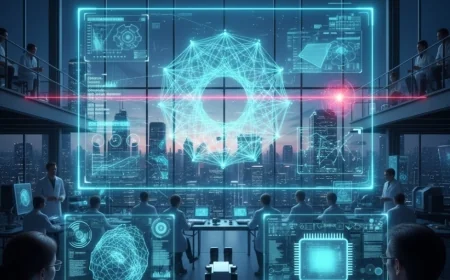
Researchers are actively exploring a new generation of computers that operate using light, or photons, instead of traditional electrical currents. Systems that rely on light to store and process information, known as photonic computers, could one day run far more efficiently and complete calculations much faster than conventional machines.
Light-driven computing remains at an early stage, primarily due to a technical obstacle: the need to control tiny streams of light traveling through a chip. Rerouting these microscopic signals without weakening them requires highly engineered materials that prevent stray light from entering from any direction. This type of substance is known as an "isotropic bandgap material."
Discovery of Gyromorphs at NYU
Scientists at New York University (NYU) have identified a new material called "gyromorphs" that meets this challenge more effectively than any other known structure. Gyromorphs combine features normally associated with liquids and crystals, yet they exceed both in their ability to block incoming light from all angles.
The discovery, reported in Physical Review Letters, introduces a fresh strategy for tuning optical behavior and could help advance the development of photonic computers.
“Gyromorphs are unlike any known structure in that their unique makeup gives rise to better isotropic bandgap materials than is possible with current approaches,” says Stefano Martiniani, an assistant professor of physics, chemistry, mathematics, and neural science, and the senior author of the study.
Why Existing Materials Fall Short
For decades, researchers have looked to quasicrystals when designing isotropic bandgap materials. While quasicrystals follow complex mathematical rules and were once considered the best option, the NYU team noted their trade-off: they either block light completely from limited directions or weaken light from all directions without fully stopping it. This limitation has driven the search for alternatives that can comprehensively block signal-degrading light.
Engineering New Metamaterials
In their research, the NYU team created "metamaterials," which are engineered structures whose properties depend on their architecture rather than their chemical composition. To overcome the challenge of designing these structures, the team developed an algorithm capable of producing functional structures with built-in disorder.
Their work revealed a new form of "correlated disorder" that sits between fully ordered and fully random extremes. As lead author Mathias Casiulis explained, gyromorphs reconcile seemingly incompatible features: they lack a fixed, repeating structure (liquid-like disorder), but at the same time, they form regular patterns when viewed from a distance.
"These properties work together to create bandgaps that lightwaves can't penetrate from any direction," Casiulis concluded, confirming that gyromorphs reconcile seemingly incompatible features and outperform ordered alternatives like quasicrystals.