



















































































































Architecture’s living turn: AI, robotics, and the rise of biofabrication
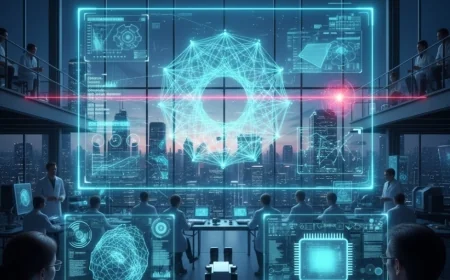
Architecture is entering a defining era — one in which artificial intelligence and robotics are no longer tools of industrial speed but agents of ecological collaboration. As cities face mounting environmental and social pressures, architects are beginning to design with nature rather than against it. The new frontier lies in biofabrication — the merging of computational design with living materials like mycelium — where growth, decay, and regeneration become part of architecture’s DNA.
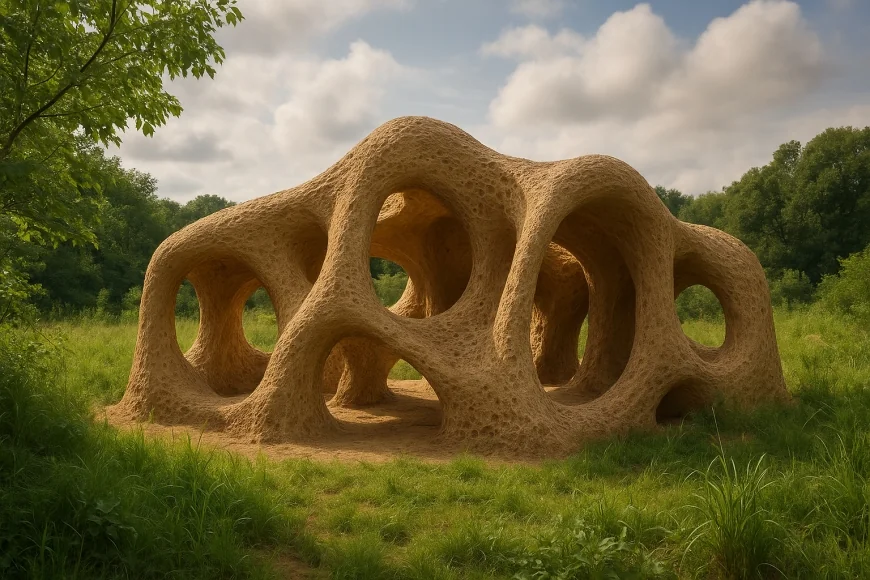
In this paradigm, printed structures are no longer inert shells. They grow, breathe, and eventually decompose. This approach reframes architecture as a living system, transforming construction from a process of extraction into one of cultivation.
From automation to regeneration
The first wave of AI and robotics in architecture, exemplified by ICON’s 3D-printed housing prototypes, emphasized speed and automation. But newer projects, such as the MycoMuseum at the 2025 Venice Architecture Biennale, are redefining these technologies through a biological lens. Instead of extruding concrete, robotic systems now cultivate mycelium-based structures — a shift from efficiency-driven design to regenerative practice.
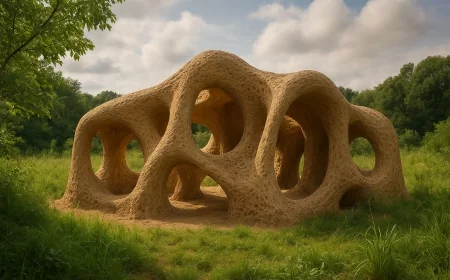
By prioritizing natural materials, AI and generative design tools simulate how living matter behaves within printed geometries. Architects can now model how mycelium expands within 3D cavities, adjusting pore sizes and structural patterns to optimize growth and strength. In experimental labs, AI systems respond to environmental data such as humidity, density, and temperature, adjusting robotic movements in real time — turning fabrication into a dialogue with living matter.
Biofabrication in practice
At the Institute for Advanced Architecture of Catalonia (IAAC), the Biofabrication Lab uses AI-driven robotics to co-create structures with biological materials. Meanwhile, ETH Zurich’s Digital Building Technologies group is pioneering extrusion methods that integrate bio-composites and adaptive, low-waste fabrication systems. These innovations suggest a new “material metabolism” for cities — one where construction, waste, and regeneration form a closed ecological loop.
Projects like the Growing Matter(s) Pavilion by Henning Larsen Architects and Blast Studio’s Tree Column demonstrate how mycelium composites can function as both load-bearing and insulating materials. Unlike traditional 3D printing, which seeks to make concrete greener, biofabrication envisions buildings that return to the soil, positioning architecture as a temporary participant in natural cycles rather than a permanent disruption of them.
Microbial intelligence and regenerative construction
ETH Zurich’s Geological Microbial Formations, featured in the 2025 Venice Biennale’s Matter Makes Sense section, uses microbial activity as a construction tool. A robotic arm layers a mix of microbes and calcium-rich compounds over crushed waste, triggering reactions that bind the material into a solid composite. This method could eventually replace energy-intensive industrial processes, enabling self-repairing or self-forming materials that grow naturally over time.
Similarly, IAAC’s concrete-coated mycelium prototype explores hybrid systems where 3D-printed shells host the growth of living materials. The result is a lightweight, insulated structure in which digital precision meets biological adaptability.
The ethics of a living architecture
These experiments signal a profound shift in architectural ethics. AI and robotics are evolving from tools of efficiency to mediators between humans and ecosystems. Instead of asking how to build faster or cheaper, architects are learning how to build responsibly — how to grow materials rather than manufacture them.
This new way of designing envisions cities as ecosystems, composed of biodegradable, responsive, and adaptive structures. Buildings cease to be static monuments and become metabolic organisms, engaged in cycles of growth, decay, and renewal.
As digital and biological systems converge, the future of architecture lies in empathy — not efficiency. By merging automation with cultivation, designers are redefining the relationship between technology and life. The cities of tomorrow will not be made to last forever but to live, breathe, and ultimately return to the earth.