
























































































































Consumer inflation expectations decline at short term, labor market outlook worsens
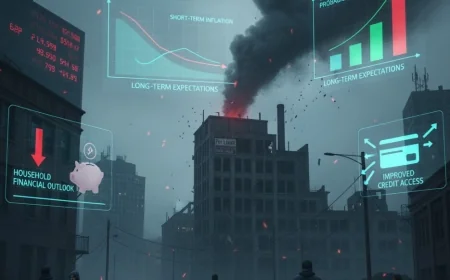
The October 2025 Survey of Consumer Expectations from the Federal Reserve Bank of New York indicates that median short-term inflation expectations decreased to 3.2%, while medium and long-term expectations remained stable at 3.0%. The labor market outlook deteriorated, with a higher probability expected for unemployment and a lower probability of finding a job. Conversely, perceptions of current and future credit availability improved significantly, though households became more pessimistic about their future financial situations.
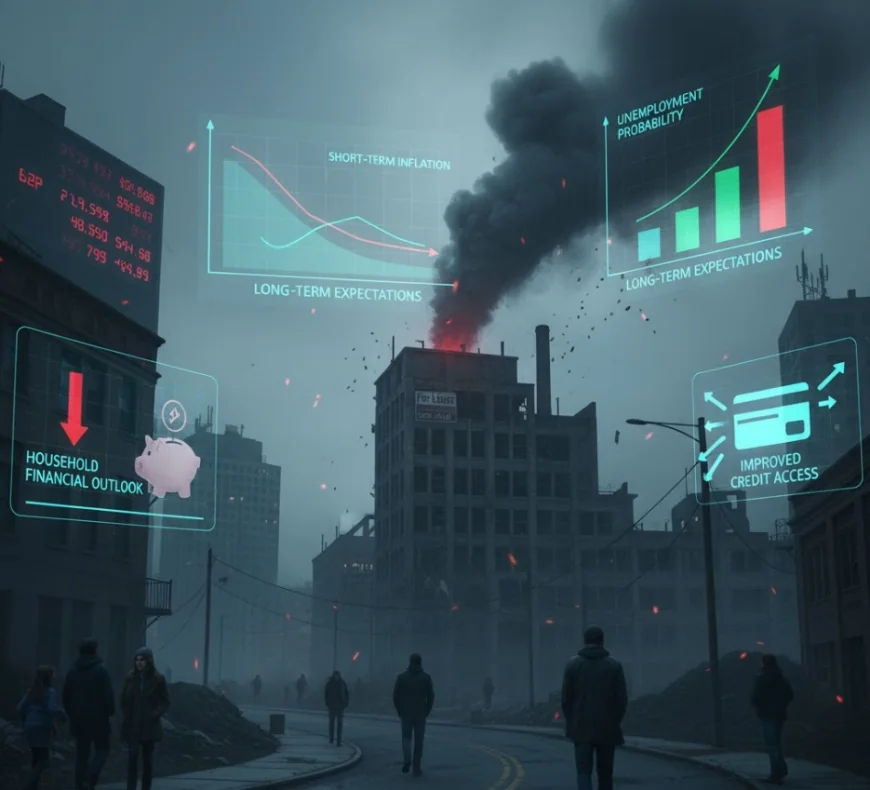
The October 2025 Survey of Consumer Expectations provides a mixed picture of the US household outlook, showing declining short-term inflation expectations but a worsening view of the labor market and future household finances. The survey was conducted throughout October 2025.
Inflation and Price Expectations
Median inflation expectations saw a decline of 0.2 percentage point to 3.2% at the one-year-ahead horizon. Conversely, expectations remained unchanged at the three-year and five-year horizons, both steady at 3.0%. The measure of disagreement among respondents regarding future inflation increased across all horizons.
Key price change expectations for the year ahead included:
-
Gas: Declined by 0.7 percentage point to 3.5%.
-
Food: Declined slightly by 0.1 percentage point to 5.7%.
-
College Education: Increased by 1.2 percentage points to 8.2%.
-
Medical Care: Increased to 9.4%, the highest reading since February 2023.
-
Rent: Increased by 0.2 percentage point to 7.2%.
-
Home Price Growth: Remained unchanged at 3.0% for the fifth consecutive month.
Labor Market Outlook Deteriorates
The overall outlook for the labor market weakened, marked by three consecutive monthly increases in unemployment expectations.
-
Unemployment Expectations: The mean probability that the US unemployment rate will be higher one year from now increased by 1.4 percentage points to 42.5%.
-
Job Finding Probability: The mean perceived probability of finding a job if one's current job were lost fell by 0.6 percentage point to 46.8%, remaining well below its twelve-month average.
-
Job Loss Probability: The mean perceived probability of losing one’s job slightly improved, retreating by 0.9 percentage point to 14.0%.
-
Earnings Growth: Median one-year-ahead earnings growth expectations increased slightly by 0.2 percentage point to 2.6%.
Household Finance and Credit
Expectations regarding household finances showed contrasting trends, with improved credit access but diminished optimism about personal financial well-being.
-
Credit Availability: Perceptions of credit access compared to a year ago improved substantially, with the smallest share of households reporting that obtaining credit is harder since February 2022. Expectations for future credit availability also improved.
-
Spending and Income: Median expected growth in household income declined slightly to 2.8%. Median year-ahead household spending growth expectations increased slightly to 4.8%.
-
Financial Situation: Perceptions of households' current financial situations worsened compared to a year ago. Year-ahead expectations about households’ financial situations also deteriorated, with a larger share of households expecting a worse financial situation.
-
Stock Prices: The mean perceived probability that US stock prices will be higher 12 months from now decreased by 0.9 percentage point to 38.9%.