




























































































































UN court issues landmark opinion on climate change and nature — a turning point for global environmental governance
In a historic moment for international environmental law, the International Court of Justice (ICJ) has issued a landmark advisory opinion affirming that states have a legal duty to prevent environmental harm, including actions contributing to climate change. The ruling — the first of its kind from the UN’s highest court — could reshape global climate governance and bolster efforts by vulnerable nations to hold major polluters accountable.
1. World Court delivers a defining opinion on state climate duties
The ICJ’s opinion establishes that all nations, whether or not they are signatories to the Paris Agreement, are obligated under international human rights and customary law to protect the climate system and safeguard future generations.
ICJ President Judge Iwasawa Yuji emphasized that failing to implement ambitious emission reduction measures would constitute a breach of international obligations.
The case was driven by small island states, including Vanuatu, which argued that industrialized nations should bear greater responsibility for historical emissions. The court’s decision — while advisory and not legally binding — is expected to influence future litigation and climate diplomacy.
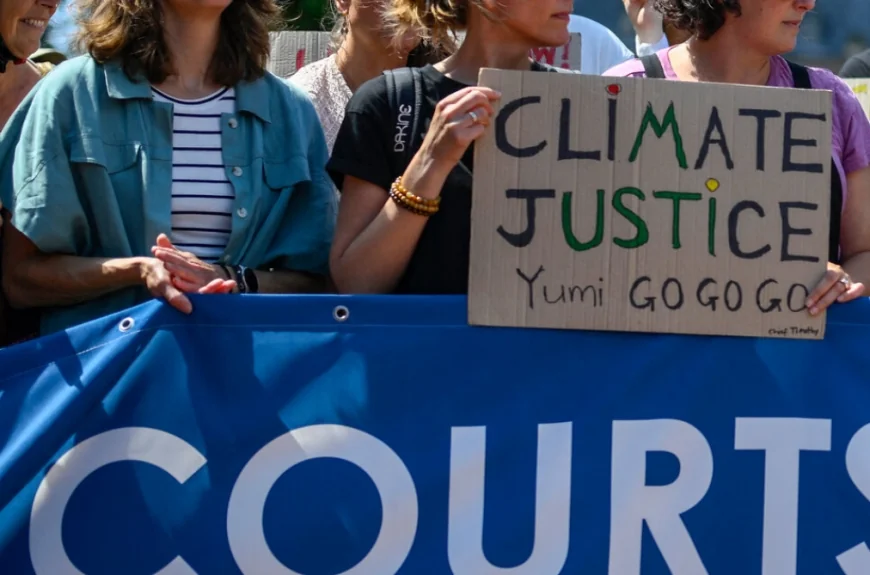
“This advisory opinion is a tool for climate justice. And boy, has the ICJ given us a strong tool to carry on the fight for climate justice,” said Vishal Prasad, a law student and climate activist, speaking to Reuters.
Vanuatu’s Climate Minister Ralph Regenvanu hailed the decision, calling it “a big step in the right direction” for vulnerable communities fighting the existential impacts of global warming.
2. UN chief: ‘Fossil fuels are running out of road’
In the wake of the ICJ ruling, UN Secretary-General António Guterres reiterated that a transition away from fossil fuels toward renewable energy is both necessary and inevitable.
“Fossil fuels are running out of road,” Guterres said, urging governments to channel investments into low-carbon and renewable energy sources that can improve energy security and affordability.
According to a new report by the International Renewable Energy Agency (IRENA), over 90 percent of renewable power projects worldwide are now cheaper than fossil fuel alternatives. The cost of solar power, once four times higher than fossil fuels, is now 41 percent cheaper, the report notes.
Guterres also called on technology companies to commit to 100 percent low-carbon electricity by 2030, highlighting their role in accelerating the global clean energy transition.
3. Global environmental challenges: this week’s developments
-
The European Union has launched a consultation to simplify its sustainability regulations, aiming to reduce bureaucracy without weakening environmental protections.
-
The United States faces a critical shortage of wildfire firefighters, with over a quarter of positions vacant at the U.S. Forest Service during peak fire season, The Guardian reports.
-
The ancient city of Alexandria, Egypt, faces severe coastal erosion, with around 40 structures collapsing annually as sea levels rise.
-
Northern China saw record rainfall, with an entire year’s worth of precipitation falling in 24 hours, triggering flash floods and infrastructure damage.
-
Peru’s seabird populations have plummeted, with the guano-producing coastal birds dropping from 4 million in 2022 to around 500,000 today — a three-quarters decline in just three years.
4. Rethinking the future of climate and water governance
Experts are calling for new approaches to climate adaptation and water risk management, as traditional methods fail to meet escalating global challenges.
In a recent World Economic Forum piece, Jose Ignacio Galindo and Nicolas Wertheimer of Waterplan argued that AI-powered water management systems can set new benchmarks for resilience and efficiency.
Meanwhile, Arunabha Ghosh and Jane Nelson highlight the urgent need for integrated policy frameworks linking energy, food, and water systems, urging policymakers to move beyond siloed approaches and embrace coordinated, systems-level governance.
A milestone for climate justice
The ICJ’s opinion represents a powerful affirmation that climate inaction can violate international law, offering a potential foundation for future claims and policy reforms. While advisory in nature, the decision marks a new era for global environmental accountability — one that may redefine how the world understands and enforces its collective duty to protect the planet.