




































































































































Ancient stone tools reveal 300,000 years of innovation and resilience in Kenya’s Turkana Basin
WASHINGTON | November 4, 2025 — In the arid expanse of northern Kenya’s Turkana Basin, early humans were quietly perfecting a technology that would outlast generations and climate chaos alike. A new study published in Nature Communications reveals one of the longest and oldest records of continuous stone tool production ever found — spanning roughly 2.75 to 2.44 million years ago — offering extraordinary insight into the technological resilience of our earliest ancestors.
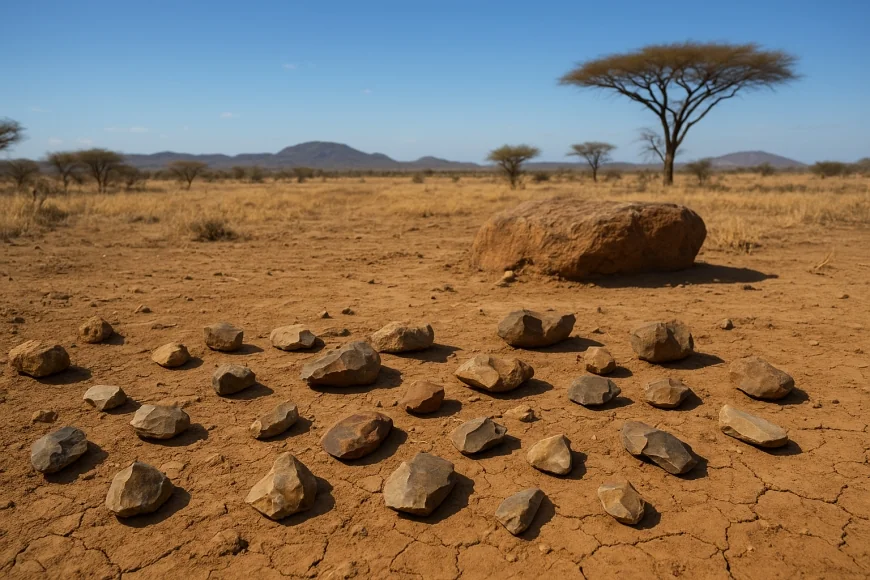
Discovered at the Namorotukunan Site, these ancient Oldowan tools — often described as the first “multi-purpose Swiss Army knives” of humankind — show a remarkable consistency in design and craftsmanship across hundreds of millennia. Despite enduring cycles of drought, wildfires, and shifting landscapes, early hominins maintained the same core toolmaking traditions, underscoring the deep roots of technological adaptation in human evolution.
“This site reveals an extraordinary story of cultural continuity,” said David R. Braun, lead author and anthropology professor at George Washington University, who is also affiliated with the Max Planck Institute. “What we’re seeing isn’t a one-off innovation—it’s a long-standing technological tradition.”
A craft that endured chaos
The study shows that early hominins were not merely reacting to environmental challenges — they were mastering them. Using techniques such as volcanic ash dating, paleomagnetic analysis, chemical fingerprinting of rocks, and microscopic plant residue studies, researchers reconstructed a vivid portrait of life amid dramatic ecological transformations.
The findings suggest these toolmakers thrived despite recurring wildfires, moving rivers, and cycles of aridity. Their durable technology — designed for cutting, scraping, and butchering — may have been the key to unlocking new dietary possibilities, including meat consumption, offering a decisive evolutionary advantage.
“Namorotukunan offers a rare lens on a changing world long gone—rivers on the move, fires tearing through, aridity closing in—and the tools, unwavering,” said Dan V. Palcu Rolier, corresponding author and senior scientist at GeoEcoMar, Utrecht University, and the University of São Paulo. “For nearly 300,000 years, the same craft endures—perhaps revealing the roots of one of our oldest habits: using technology to steady ourselves against change.”
Expert insights from the field
Archaeologists say the tools display an astonishing level of standardization and skill:
“By about 2.75 million years ago, hominins were already adept at making sharp stone tools, suggesting the Oldowan tradition began earlier than we thought,” noted Niguss Baraki, George Washington University.
Other specialists emphasize the connection between tool use and evolving diets.
“At Namorotukunan, cut marks link stone tools directly to meat eating, revealing a broadened diet that persisted through changing climates,” said Frances Forrest, Fairfield University.
And for Rahab N. Kinyanjui of the National Museums of Kenya and the Max Planck Institute, the plant fossil record tells a tale of adaptation:
“The landscape shifted from wetlands to dry, fire-swept grasslands and semideserts. As vegetation changed, the toolmaking remained steady. This is resilience.”
A global collaboration
The study — “Early Oldowan technology thrived during Pliocene environmental change in the Turkana Basin, Kenya” — was led by an international consortium of archaeologists, geologists, and paleoanthropologists from Kenya, Ethiopia, the United States, Brazil, Germany, India, the Netherlands, Portugal, Romania, Spain, South Africa, and the United Kingdom.
Fieldwork was conducted with support from the National Museums of Kenya, in close partnership with the Daasanach and Ileret communities.
Funding was provided by the U.S. National Science Foundation, The Leakey Foundation, the Palaeontological Scientific Trust, the Dutch Research Council, the Fundação de Amparo à Pesquisa do Estado de São Paulo, the American Museum of Natural History, and the Romanian National Authority for Scientific Research.
“Our findings suggest that tool use may have been a generalized adaptation among our primate ancestors,” said Susana Carvalho, Director of Science at Gorongosa National Park and senior author of the study.
Together, the discoveries at Namorotukunan illuminate a simple truth about human origins: even amid profound environmental upheaval, innovation — once sparked — can endure for millennia.