




































































































































4,000-year-old Dilmun temple unearthed on Kuwait’s Failaka Island reveals ancient Gulf civilization’s hidden heart
Kuwait’s Failaka Island has yielded one of its most extraordinary archaeological finds in decades — a 4,000-year-old temple belonging to the powerful Bronze Age Dilmun civilization, uncovering new evidence of the island’s vital role in ancient trade, religion, and administration.
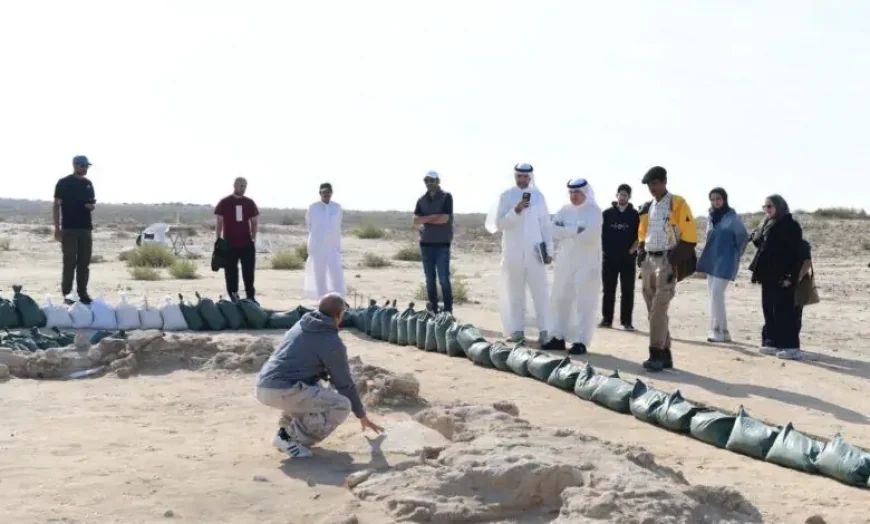
The discovery, announced by a joint Kuwaiti–Danish archaeological team, marks the second Dilmun temple uncovered on the exact same site, stacked one atop the other. This rare architectural sequence suggests that Failaka was not just a settlement, but a spiritual and political center of enduring importance in the ancient Gulf world.
A rare double-temple discovery
Excavations at the mound known as Tell F6, located just east of the island’s Dilmun palace and temple district, have revealed the complete layout of the newly discovered structure. Beneath it lay the remains of an earlier temple unearthed last year — both dating between 1900 and 1800 BCE.
“Two temples were built on the same site, one atop the other, both dating back roughly 4,000 years,” said Mohammed bin Redha, Acting Assistant Secretary-General for the Antiquities and Museums Sector at the National Council for Culture, Arts and Letters (NCCAL). He emphasized Kuwait’s commitment to preserving the nation’s deep heritage and supporting international archaeological missions.
Lead excavator Dr. Ole Herslund noted that earlier surveys had only revealed scattered wall fragments, once thought to be part of a small shrine. This season’s dig, however, exposed stone foundation walls, multi-roomed layouts, and a central chamber consistent with other Dilmun ritual sites in Bahrain and eastern Arabia.
Unearthed artifacts tell a story of trade and ritual
Archaeologists recovered a remarkable array of artifacts, including:
-
Seals and seal impressions used in trade and administration
-
Pottery sherds typical of early Dilmun craftsmanship
-
Beads and carved fragments linked to adornment and ceremonial functions
-
Stone foundations outlining a rectangular, multi-chambered temple structure
These findings confirm that the site functioned as both a religious sanctuary and an administrative hub, integral to the Dilmun civilization’s complex trade networks.
Failaka: crossroads of ancient trade
Situated at a strategic maritime junction between Mesopotamia, eastern Arabia, and the Indus Valley, Failaka Island was ideally positioned for long-distance commerce. During the Bronze Age, Dilmun acted as a middleman civilization, facilitating the exchange of copper, textiles, pottery, beads, and gemstones across regions that now form parts of Kuwait, Bahrain, and Saudi Arabia.
The newly uncovered temple reinforces the idea that Failaka served as:
-
A ritual and communal center for the Dilmun people
-
A meeting point for merchants and travelers across the Gulf
-
A permanent settlement with administrative authority, not a temporary outpost
The world of Dilmun
The Dilmun civilization flourished between 3000 and 1600 BCE, and is frequently referenced in ancient Mesopotamian texts as a mythical “land of purity and life.” Archaeological evidence now suggests that its people — traders, sailors, and artisans — established permanent communities on Failaka, blending spiritual devotion with maritime commerce.
Rediscovering the Gulf’s ancient identity
For Kuwait and the wider Gulf, this temple is far more than an archaeological site — it is a window into a forgotten world. Its stones and carvings still whisper of rituals, trade, and community life that thrived four millennia ago.
As scholars continue to study the find, the discovery at Failaka stands as a powerful reminder that the Arabian Gulf was not a periphery of civilization — it was one of its engines.