






































































































































Traces of submerged city discovered beneath Lake Issyk-Kul
Archaeologists from the Russian Academy of Sciences have discovered traces of a submerged city beneath the surface of Lake Issyk-Kul in eastern Kyrgyzstan.

Located in the western Tianshan Mountains, Lake Issyk-Kul is an endorheic saline lake and the 8th deepest lake in the world. During the Middle Ages, the lake served as a crucial stopover on the Silk Road, the ancient land route connecting the Far East to Europe.
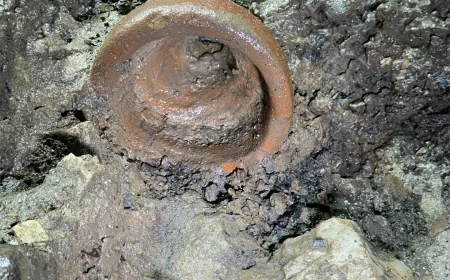
Recent excavations at the Toru-Aygyr complex in the lake’s northwestern part have led to the discovery of a medieval necropolis, fired-brick structures, and numerous ceramic vessels.
Researchers surveyed four underwater zones at depths of 1 to 4 meters. In the first area, they uncovered numerous fired-brick structures, including one containing a millstone—evidence of a medieval mill once used to grind grain into flour. The team also documented collapsed underwater stone structures and wooden beams, in addition to traces of a public building that possibly served as a mosque, bathhouse, or madrassa.
“The site we are studying was a city or a major trading hub on a key section of the Silk Road,” explained Valery Kolchenko, researcher at the National Academy of Sciences of the Kyrgyz Republic and host of the expedition.
According to the researchers, the region was devastated by a major earthquake during the 15th century, causing the settlement to sink beneath the water and ultimately leading to its abandonment.
Further zones revealed a 13th to 14th century Muslim necropolis, evidence of the settlement’s later expansion with additional buildings, and an earlier burial ground that was eventually overbuilt by new structures.
The excavation, conducted jointly by the Institute of Archaeology of the Russian Academy of Sciences with the National Academy of Sciences of Kyrgyzstan, will form the basis for future research aimed at preserving Issyk-Kul’s underwater heritage.