





























































































































Israel reportedly preparing multi-day operation in Lebanon as Hezbollah rebuilds forces; Iran deepens defense ties with Belarus
Israel is reportedly preparing plans for a possible multi-day operation targeting Hezbollah leadership and infrastructure across Lebanon amid Hezbollah’s efforts to reconstitute its forces.
Several Israeli media outlets reported on November 4 and 5 that the Israel Defense Forces (IDF) are preparing plans for a “several-day” operation in which the IDF would target Hezbollah infrastructure south of Beirut, in the Bekaa Valley, and in other areas north of Lebanon’s Litani River. The reports did not specify whether the operation would include ground incursions.
Discussions in Israeli media about a new IDF operation in Lebanon follow recent reports from Israeli and Western sources that Hezbollah is reconstituting its forces and weapons capabilities in Lebanon through domestic production and smuggling. Israeli Prime Minister Benjamin Netanyahu convened a special session on November 4 to discuss Hezbollah’s recent smuggling of short-range rockets into Lebanon from Syria.
Israeli intelligence officials warned that Hezbollah is producing more ammunition domestically than Israel is able to destroy, with assessments suggesting that Hezbollah could soon cross Israel’s “red line” for offensive capabilities.
U.S. and Israeli officials have recently warned Lebanon that any Israeli operation would be a direct consequence of the Lebanese Armed Forces’ (LAF) failure to act against Hezbollah’s reconstitution. Washington’s Special Envoy Thomas Barrack reportedly told Beirut that Israel “will be able” to strike Lebanon if the LAF does not take stronger measures to disarm Hezbollah by the end of November 2025.
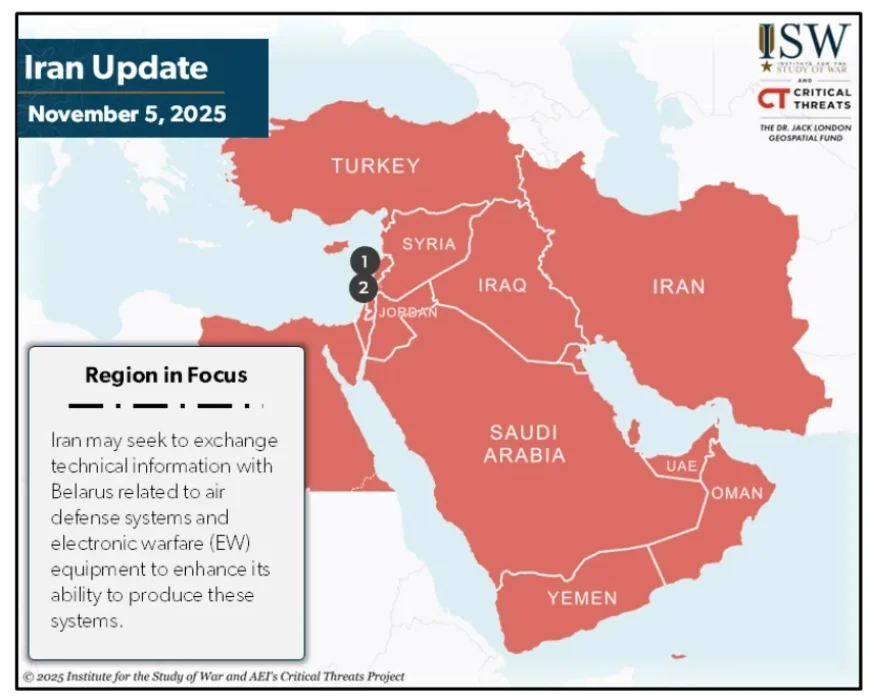
Meanwhile, Iran and Belarus have strengthened defense cooperation. Iranian Artesh Air Force Commander Brigadier General Hamid Vahedi met Belarusian Air Force and Air Defense Commander Major General Andrei Lukyanovich during a visit between November 2 and 5. The two sides discussed expanding air force and air defense collaboration, including exchanges on radar and electronic warfare systems.
Analysts suggest Iran could use cooperation with Belarus to enhance its own air defense production, leveraging Belarus’ experience in manufacturing radar and electronic warfare systems compatible with Russian-made platforms. However, given Russia’s deep control over Belarus’ defense sector, such transfers would likely require Moscow’s approval.
Separately, Iran has been promoting its naval hardware at Pakistan’s International Maritime Exhibition and Conference (PIMEC), displaying models of anti-ship missiles, submarines, and fast attack craft. The move reflects Tehran’s ongoing effort to increase arms exports amid Western sanctions.
In Iraq, Prime Minister Mohammad Shia al-Sudani claimed that the U.S. military presence encourages Iranian-backed militias to remain armed — a statement Washington rejected, calling disarmament an “Iraqi sovereign duty.” The U.S. is currently transitioning from the multinational Operation Inherent Resolve to a bilateral security framework focused on countering Iranian influence.